
“Bitcoin rises when money flows into the system.”
This phrase is repeated often in crypto markets, but very few people stop to ask what it actually means. Liquidity is not a single number. It is the result of several mechanisms that determine how much money is actually circulating in the financial system. To understand this better, we need to look at three key components of the system:
- the central bank’s balance sheet
- government cash flows
- the structure of money markets
When these three move in the same direction, markets tend to experience powerful moves.
Money in markets works like a water system
A simple way to think about liquidity is to imagine the financial system as a reservoir. Money is the water. If more water flows into the reservoir, capital becomes available for investments. Risk assets tend to rise. If water is drained from the system, liquidity tightens and markets often struggle. The level of water in the system is controlled by three main valves:
- the central bank
- government cash management
- money markets
Understanding how these interact gives a much clearer picture of what is actually happening in financial markets.
The role of the central bank
The central bank can add liquidity by buying securities from the market. This process is known as quantitative easing (QE). When the central bank buys bonds:
- it pays for them with newly created money
- bank reserves increase
- financial conditions loosen
This was one of the key reasons markets rose strongly during the 2020–2021 period.
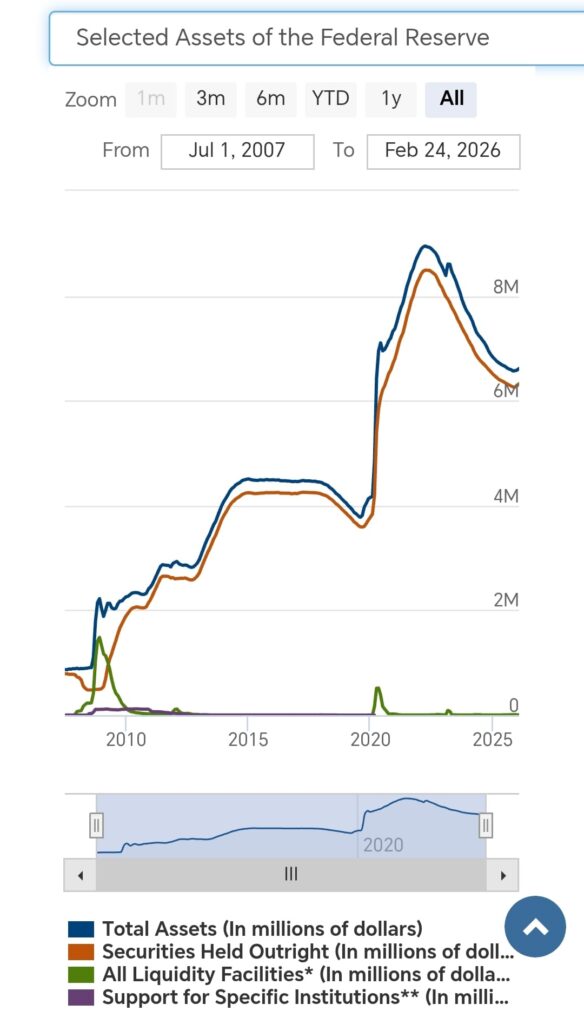
When the central bank does the opposite and shrinks its balance sheet (QT), liquidity leaves the system. Financial conditions tighten and risk assets often struggle. This tightening cycle was one of the major drivers behind the 2022 bear market.
The government’s bank account – an underrated liquidity factor
Another important but often overlooked factor is government cash management. The U.S. government holds its primary account at the central bank. This account is called the Treasury General Account (TGA).
When people and corporations pay taxes, money moves from the banking system into the government’s account. In practice this means liquidity is temporarily removed from markets. When the government spends money, the opposite happens. Salaries, social security payments, infrastructure spending and other government expenditures push money back into the financial system.
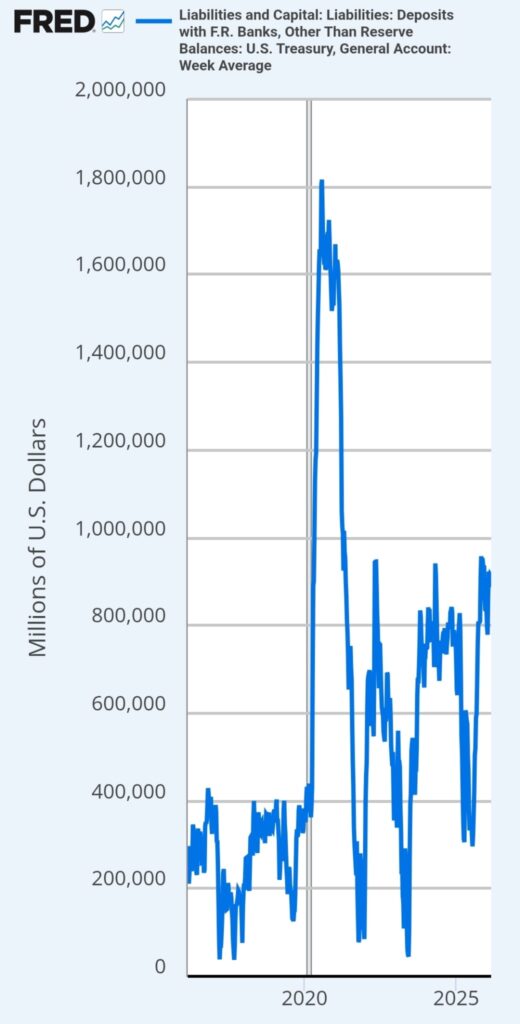
The TGA therefore acts as a temporary storage for liquidity. Large swings in this account can have a surprisingly meaningful impact on market liquidity.
Reverse Repo – the system’s liquidity buffer
In recent years another important component of the liquidity system has been the reverse repo facility (RRP). This facility allows money market funds and other institutions to park excess cash at the Federal Reserve overnight. At its peak, more than two trillion dollars was parked in this facility.
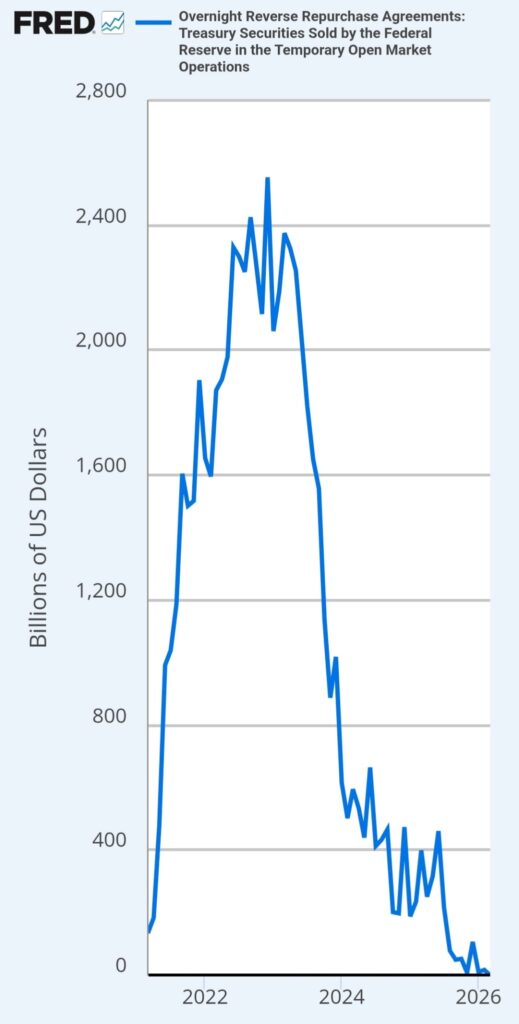
For a period of time this pool of capital acted as a buffer for the system. If liquidity conditions tightened, money could effectively flow back into markets as RRP balances declined. Over the past few years, however, this buffer has almost completely disappeared.
Where we are now
The current macro environment is unusual because several things have happened at the same time.
The central bank has stopped aggressively shrinking its balance sheet.
The reverse repo facility has been largely drained.
And government cash balances remain relatively elevated.
In practice this means the excess liquidity buffer in the system has largely been used up. Markets are now far more sensitive to actual cash flows than they were a few years ago. Small changes in government spending or tax inflows can now have a much larger impact on liquidity conditions.
What will drive markets next
Because the reverse repo buffer has mostly disappeared and the central bank is not actively expanding its balance sheet, one variable becomes especially important:
Government cash flows.
If the government begins spending more and the TGA declines, money flows back into the banking system and liquidity increases. If the government instead collects more cash from markets, the TGA rises and liquidity is removed. This dynamic is currently one of the most important macro drivers to watch.
Why this matters for Bitcoin
Bitcoin is still a relatively small asset compared to equities or sovereign bond markets. Because of this, it often reacts strongly to changes in global liquidity conditions. When liquidity expands, risk assets tend to rise. When liquidity tightens, risk assets often struggle or move sideways.This is not a perfect rule, but historically the relationship between liquidity conditions and Bitcoin’s price has been surprisingly strong.
Conclusion
Macro markets can often look complicated, but at their core they revolve around a very simple question:
Is the amount of money in the system increasing or decreasing?
Right now the most important variables to monitor are:
- the central bank’s balance sheet
- government cash balances (TGA)
- money market liquidity
If liquidity begins to expand again, risk assets will likely have room to move higher. If liquidity tightens, markets must operate with less available capital. And ultimately, this — not a single headline or narrative — is often what drives the largest moves in financial markets.
— MastertheEdge
Sources: Federal reserve. Federal Reserve Economic Data (FRED)