
”Bitcoin is too volatile.” ”Bitcoin is a fully debt-leveraged market.” These are the common criticisms often repeated in discussions about Bitcoin.A frequent claim is that Bitcoin is bad money because you never know what its value will be tomorrow. But the issue is far from black and white.In many cases, this argument stems from a misunderstanding – particularly a failure to understand what actually drives Bitcoin’s volatility and how emerging monetary assets historically behave in their monetization phase.
Bitcoin’s price rises when it is being bought. Bitcoin’s price falls when it is being sold. This is obvious to everyone. When you combine short-term irrational and extreme price movements with a lack of understanding Bitcoin, you are almost guaranteed to end up calling it a scam.Volatility is not the same as risk of permanent capital loss. It is a measure of price dispersion over time.The key question is whether volatility reflects structural weakness – or early-stage price discovery.
What actually drives volatility?
Bitcoin is still a relatively small asset compared to gold, equities, or sovereign bond markets. When an asset has a smaller market capitalization and thinner liquidity, even moderate capital flows can cause outsized price movements.
This structural reality means that price swings are often a function of liquidity depth rather than a fundamental reassessment of value. In future articles, I will examine liquidity conditions in greater detail, including market depth, leverage dynamics, and broader monetary liquidity cycles, to better understand how these factors amplify volatility in practice.
Beyond market structure, volatility is also influenced by human behavior. In poker, players seek to maximize their “outs” — the number of possible cards that can improve their hand — because asymmetric outcomes increase the potential payoff. Similarly, many investors are drawn to assets that combine uncertainty with the possibility of significant upside.
At the same time, people construct narratives to make sense of complex phenomena. Bitcoin invites multiple interpretations. Some investors pursue high returns. Others are motivated by monetary sovereignty and independence from central banks. A third group views Bitcoin as a technological breakthrough and the future of global payments, while others see it as protection against inflation.
These differing motivations do not compete — they compound. When multiple investment theses coexist within a single asset, they broaden the base of potential buyers. The result is structurally strong but shifting demand, which in turn contributes to volatility as dominant narratives evolve over time.
Institutional investors and rebalancing
When the price rises enough, large investors begin taking profits. It is important to understand that institutional investors evaluate their portfolios through a risk-return framework.They understand the fundamental principles of investing mentioned earlier.When their Bitcoin positions reach a certain size, they seek to rebalance their portfolios. This behavior is consistent with standard portfolio theory rather than unique instability.If Bitcoin eventually reaches a broader consensus as a lower-risk asset, this type of selling will likely decrease.
Another factor is macroeconomic conditions. The largest holders closely monitor macro indicators and may sell if the probability of broader market risks increases. When different investor groups operate with different time horizons, short-term volatility becomes a natural byproduct of long-term adoption.
Monterary Liquidity and Market Volatility
A recent example can be seen in the Federal Reserve’s quantitative tightening cycle and its subsequent pause. When the Fed reduces its balance sheet, system liquidity contracts.Conversely, when tightening slows or liquidity stabilizes, risk assets often respond positively. At the same time , facilities such as the Reverse Repo Program reflect excess liquidity in the system. A rapid decline in reverse repo balances, combined with changes in the Fed’s balance sheet trajectory, can significantly alter short-term risk sentiment.
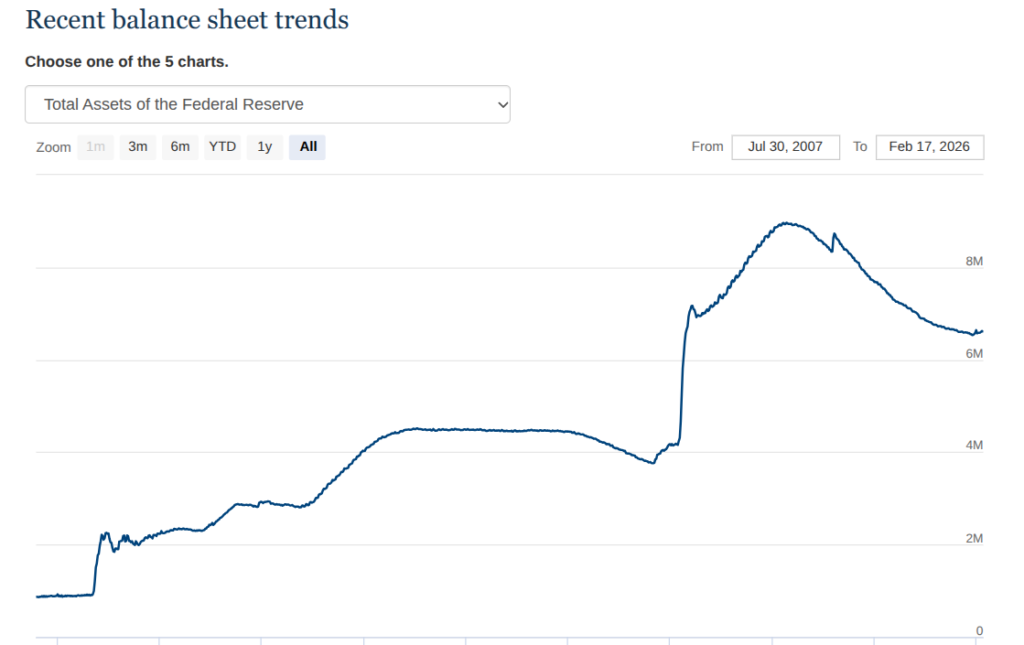
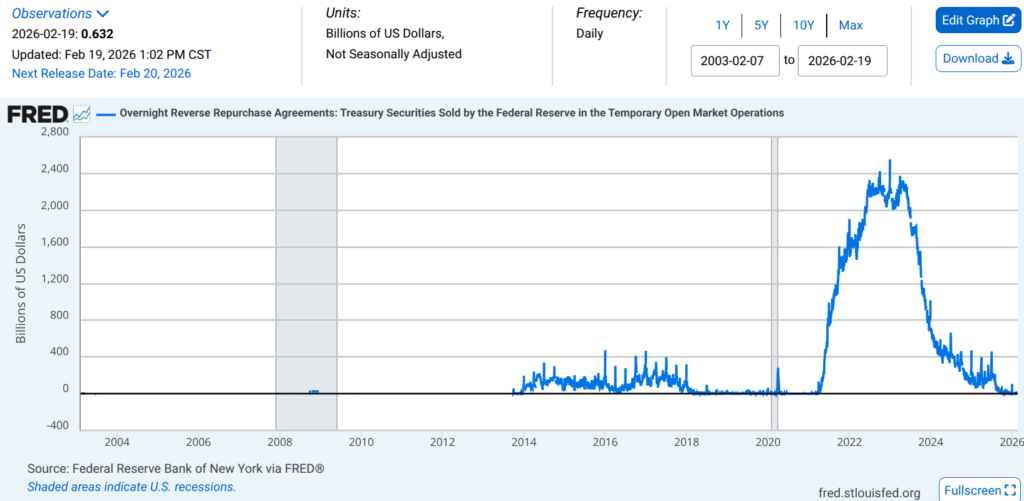
These liquidity dynamics do not determine Bitcoin’s long-term proposition, but they can amplify short-term volatility as macro-sensitive capital reallocates.
Summary
If Bitcoin critics consider all of the above to be ”bad” sources of volatility, then in my view they do not understand the fundamentals of Bitcoin and investing.As long as Bitcoin possesses these characteristics and people believe in them, it is irrational not to allocate at least a small portion of a portfolio to Bitcoin and crypto, given the potential involved.
In other words, the combination of exceptionally strong demand and the fact that Bitcoin is still in the early stages of its development makes the asset highly volatile.
In the next article, we will examine Bitcoin’s volatility through historical data, market liquidity and risk-adjusted performance metrics.
The above is not investment advice, but my personal opinion based on years of experience in high-risk investing.
-MastertheEdge